First appearing during a 1925 Broadway show, the Jimmy McHugh song "I Can't Believe That You're in Love with Me" was featured prominently in the 1945 film noir classic Detour. Being such an integral part of the plot and soundtrack, I thought perhaps it had been introduced in the film. I was wrong.
I didn't know Frankie had ever done a version of "Let's Get Lost." This recording seems to be from one of his numerous appearances on radio during the 1940s, probably at the height of "Sinatramania." It's sort of odd to hear him doing this, other than the person I've always identified the tune with, Chet Baker. I'm fairly certain Sinatra had a completely different concept of "getting lost" than Baker did (LOL)!
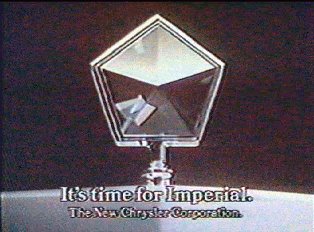
Frank Sinatra had a part in convincing thousands of people to purchase vehicles from struggling car company, Chrysler. These are the vehicles that led to Chrysler going bankrupt and requiring government intervention to completely avoid going out of business.
I've done posts before about "I've Got You Under My Skin," but, my G*d, this live performance of it by Sinatra is fantastic. It's nearly perfect. Based on his hair/toupe length/color and quality of "the voice," I'd place this around 1969 or 1970, just before he retired. I must admit, I felt the electricity when he looks into the camera for the first time around :40-:43. It's Frank Sinatra!! The post title is a reference to around 1:45 in the video. Nobody could swing like Sinatra.
"Considering that 1965 marked a mere twenty-five years since Sinatra had left Harry James, one wonders if he would have gone through with this rather premature contemplation of his old age had he known he had not even begun the second half of his solo performing career."
"Mama Will Bark" is a novelty song written by Dick Manning and performed as a duet between Frank Sinatra and Dagmar in 1951. The song was recorded at the behest of Columbia Records A&R head Mitch Miller, who had been intrigued by the comic chemistry he perceived between Sinatra and Dagmar during her appearances on Sinatra's CBS television program, The Frank Sinatra Show.
Dagmar's talents on full display
The recording, which features off-key singing by Dagmar and sound effects of dogs barking, is commonly cited as an emblematic low point in Sinatra's troubled later years at Columbia. Sinatra himself later said of the song: "The only good it did me was with the dogs." Nonetheless, the single (which did not receive an album release) was a hit, nearly reaching the Top 20 on the Billboard singles chart.
Yep, just squirmed and squinted my way through the otherwise excellent A Single Man. I can see why Colin Firth was nominated for an Academy Award. He's really good in this. I'm hesitant to use the term "transcendent," but his performance is somewhere in that neighborhood. You'd never know it was the same guy who was Lord Wessex in Shakespeare in Love or the dude in that Amanda Bynes movie.
One thing you learn about Sinatra and Sinatra's singing style is that he pretty much stuck to the notes of the melody of whatever song he was singing. Or as he was like to say during sessions in the studio: "If it ain't on the page, don't play it." He rarely diverted from this philosophy, occasionally bending notes, especially during his later, jazzier, Reprise era recording career. So, knowing well every nuance of Frank's, it was cool hearing (for the very first time) Etta James' version from her legendary 1961 At Last! album make a crucial appearance on the movie's soundtrack. Wow! It's as if they applied an "At Last" template to the song or something:
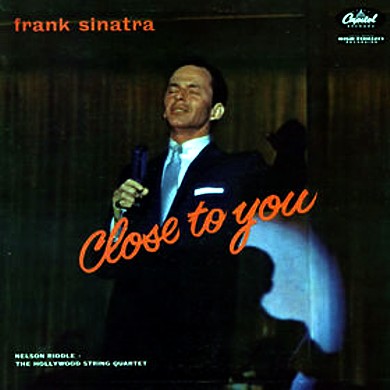
"Blame It on My Youth" is a jazz standard written by Oscar Levant and Edward Heyman in 1934. Frank Sinatra recorded a version in 1957 on the Close to You album, accompanied by pal Felix Slatkin and his Hollywood String Quartet. Although it's a mellow ballad similar to the things he recorded during his youthful, Columbia days, you can hear the crooner's years (just having turned 41) beginning to catch up with him here, when during the first time he sings "my" (as in blame it on my youth), his voice crackles just a bit due to the years of smoking and late nights. Often while performing on stage or in the recording studio, he would insert little jokes like "I think I swallowed a shot glass" or "Why'd I sleep in the pool?" if his voice faltered.
**"All the Things You Are" - recorded on January 29, 1945, in Hollywood. Sinatra nails the uncharacteristically high note at the end!
When they composed "All the Things You Are," Hammerstein and Kern were at the apex of their songwriting brilliance. "The dearest things I know a what you are" is one of the greatest romantic lines ever written. (Sinatra 101: 101 Best Recordings and the Stories Behind Them, page 11)
"Embraceable You" - December 19, 1944
"She's Funny That Way" - December 19, 1944
"If I Loved You" - May 1, 1945
**"These Foolish Things" - July 30, 1945
"The Song Is You" - March 10, 1946
**"Time After Time" - an absolute favorite, perhaps my favorite of Sinatra's Columbia period. It's just so lovely.
A warmly passionate reading by Sinatra and a virtually flawless vocal performance. Axel Stordahl's orchestration perfectly complements the marvelous breath control and impeccable phrasing of the singer.
A high point in the collaborative work of Styne and Cahn, this ballad was written for the film It Happened in Brooklyn, starring Frank Sinatra. (Sinatra 101: 101 Best Recordings and the Stories Behind Them, page 19)
It Happened in Brooklyn, 1947
"Always" - January 9, 1947
**"But Beautiful" - August 17, 1947
"Night and Day" - October 22, 1947
"Fools Rush In" - October 31, 1947
**"Body and Soul" - November 9, 1947
"Lover" - April 14, 1950, this is an early appearance of the swingin' tempo Sinatra would use so effectively at Capitol Records during the 1950s.
"Nevertheless" - October 9, 1950
"I'm a Fool to Want You" - March 27, 1951, the "Ava Gardner song." Supposedly, after this take, Sinatra walked out of the studio, exhausted, spent, done for the recording session.
"The Birth of the Blues" - June 3, 1952, though still a Columbia Records recording, this is the beginning of Sinatra Phase II:
"The Birth of the Blues" may be the first great recording of the mature Sinatra. Certainly a harbinger of things to come. On this track, Sinatra employs a rough guttural sound that he would call upon in the 1950s to "punch up" his swing tunes. This technique would serve Sinatra well for more than four decades. (Sinatra 101: 101 Best Recordings and the Stories Behind Them, page 34)
I find this Frank Sinatra performance of "Hello, Young Lovers" to be very poignant. The date was May 5, 1951, and it was on The Frank Sinatra Show. Sinatra's career was virtually unrecognizable from what it had been at its pinnacle in the mid-40s. At moments throughout this particular episode, Sinatra seemed to be trying way too hard; desperate even - smiling a little bit too easily and often, nervous, stumbling over his words in several places, not to mention the pencil-thin mustache. It's a little unnerving to watch a Sinatra who isn't confident. But I guess that's what happens to a guy when he falls from the very top of the Hollywood food chain, and everyone (but a few) kicks him as he falls.
It was a low point in the singer's career. His record sales declining, dumped by his movie studio, his radio series canceled, and perhaps most frighteningly, sidelined for over a month with a ruptured vocal cord, Frank Sinatra was in the depths of despair. He was dogged by bad press, due to an affair with movie star Ava Gardner while still married to first wife Nancy. It didn't help that his thin skin and ill temper (not to mention an overindulgence in alcohol) sometimes fueled violent confrontations with reporters and photographers he felt had wronged him.
So it was that, in 1950, Sinatra found himself casting about for a vehicle that could help him resuscitate his career. Television was the new thing and had helped a number of has-been entertainers, so why not give it a try?
The show was plagued with problems right off the bat, suffering from disappointing ratings, a high turnover in personnel, and a shortage of sponsor support.
But on this evening, he had his voice. Sinatra sang "When You're Smiling," "If," a duet with June Hutton on "My Romance," and as a lonely figure, wringing his hands while strolling quickly out into the bright spotlight of a darkened stage, "Hello, Young Lovers." Maybe I read too much into these things, but it's as if he's appealing directly to his Bobby Soxer fans, who'd all grown up and lost interest, to like him anew ("Hey! Remember me?"):
The fact this is at the Paramount Theatre, where the whole "Swoonatra" craze began in 1942, just adds an extra layer of Sturm und Drang (or angst).
Better days would come for Francis Albert Sinatra...
Sinatra's last recording for Columbia Records--and appropriate in the context of his life. Gone was the innocent, naive singer of the previous decade. Burned by love, the singer is able to convey the darkness, the sadness, and the cynicism that would characterize much of his work in the years to come. (p. 35)
Sinatra would re-record it while under contract with Capitol Records for the No One Cares album in 1959.
Here is Cy Coleman's utterly charming, 1957 performance of "Why Try to Change Me Now," from something called "Art Ford's Greenwich Village Party," which appeared to be somewhat like a precursor to the Playboy After Dark TV program of the late '60s. Coleman, by the way, also wrote "Witchcraft" for Sinatra:
Released in 1963, The Concert Sinatra is one of many under-appreciated artistic gems from under-appreciated artist Frank Sinatra's long recording career. Some info. from the Wikipedia entry:
The title refers to the larger-than-normal orchestra Nelson Riddle gathered for this recording; it is not a documentation of a live performance. This was Frank Sinatra's most fulfilling album of his early Reprise career. It was allegedly Nelson Riddle's favorite Reprise album and was originally recorded on 35mm tape.
Sinatra finds new ways to put over very heavy ballads in The Concert Sinatra... (p. 259)
Richard Rodgers and Oscar Hammerstein
...The Concert Sinatra derives just as much from Sinatra's career-long quest for extended song forms as it does from his partnership with Riddle...Concert goes for the most high-browed works they can transform into ambitious "concert" arrangements. Concert also represents the closest Sinatra would come to a composer "songbook" album...All but one (Kurt Weill's "Lost in the Stars") of its eight extended selections derive from Richard Rodgers and/or Oscar Hammerstein. (pp. 260, 261)
Nelson Riddle in 1960
If the 1956 Close to You represented Sinatra and Riddle at their most intimate, Concert Sinatra finds them at their most epic. Where Close utilizes a chamber group, Concert deploys a complete symphonic contingent. (p. 261)
Old-fashionedness was exactly what Sinatra and Voyle Gilmore (Sinatra's Capitol Records producer) were looking for when they assigned Jenkinsthe task of orchestrating A Jolly Christmas with Frank Sinatra. The twelve tracks on this seasonal set fairly hang from the chimney with simplicity. That's because Jenkins has chosen to wait before letting his cat of high, moaning strings out of his Santa sack. "I'll Be Home for Christmas" contains the sole discernible glimmer of the patented Jenkins string sound, and even there it's audible only for a brief instrumental passage.
Christina (Tina), Frank, and Frank, Jr.
Intriguingly, the most distinctive chart is the least Jenkinsy of them all: the opening "Jingle Bells" commences with the chorus cooing a jivey "Rag Mop" version of the ancient tune, over which Sinatra swings lightly and politely.
Whether he's tossing off references to "baby" or "Jack" with Billy May or ever so sincerely intoning "Merry Christmas" at the end of Sammy Cahn's "Christmas Waltz," Sinatra is never less than convincing. He even seems to have talked himself into believing that it was really Christmas--after the third and final date. Sinatra traded in his "ring-a-ding ding" for a "ho! ho! ho!" when he threw a Christmas party for the musicians, chorus, and engineers in the middle of July. (pp. 337, 338)
My two cents worth and humble onion is, even I, a committed Sinatra-phile, have a difficult time taking him seriously on several of these. It's particularly hard to accept him singing some of the more "sacred," almost hymn-like, things such as "Silent Night," "Adeste Fidles," or "Oh Little Town of Bethlehem," especially knowing as much about his private life and personal philosophy as I do. But, I absolutely adore a few of them, particularly "Mistletoe and Holly" and especially "The Christmas Waltz" (man, that's pretty). Enjoy:
Merry Christmas, Merry Christmas may your every New Year dream come true!
Released on Sinatra's own Reprise Records label in 1963, recorded that same year over two April days in Hollywood, Sinatra's Sinatra is
an album inspired by economic rather than artistic necessity, it attempts to compete in record stores with earlier hits still controlled by Columbia and Capitol (Sinatra's previous two record labels). Yet Sinatra's Sinatra remians true to its concept of presenting new versions of Sinatra's personal favorite songs and not merely regurgitating the twelve titles that happened to sell the biggest for a higher royalty rate on his own label. (from Sinatra! The Song Is You: A Singer's Art by Will Friedwald, p. 259)
I put this post together primarily for myself (sometimes I think the only audience for these posts) because this seemed to be the best, quickest way to hear both versions of each song, back to back. If some distant soul, perhaps from this very planet, should stumble across this in some distant, future date, then good on you, mate.
I wasn't aware Sinatra had recorded "Second Time Around" or "Pocketful of Miracles" at any other label other than Reprise, and I couldn't find them if those versions existed anyway, so I don't include those two songs here. Likewise, I didn't include "Call Me Irresponsible" or "Put Your Dreams Away (For Another Day)," either, because I could find only one label's version. The crooner recorded at least three different versions of "Put Your Dreams Away," one for each recording company.
"I've Got You Under My Skin" 1956 (Capitol Records)
1963
"In the Wee Small Hours of the Morning" 1955 (Capitol Records)
1963 Perhaps the best "redo" from the album. The intro alone takes my breath away (so to speak).
"Nancy (with the Laughin' Face)" 1945 (Columbia Records)
1963
"Witchcraft" 1957 (Capitol Records)
1963
"Young at Heart" 1953 (Capitol Records)
1963
"All the Way" 1957 (Capitol Records)
1963
"(How Little It Matters) How Little We Know" 1960 (Capitol Records)
1963
"Oh! What It Seemed to Be" 1945 (Columbia Records)
1963
A pretty good set of songs, any way you (me, myself and I) look at it!




 :
:




 as a guide, here are the songs which are considered to be the best of the best among the ones Frank Sinatra recorded during his time with