Apparently, the owner of this construction company in Lufkin has an interesting approach to the use of its marquee. I spotted this Wednesday morning and did a double take. I'm befuddled by the message (which was on both sides of the sign). Is it a tribute to the 1975 Paul McCartney and Wings album, Venus and Mars? What else could it be? I'll check it in a week or so to see what's there.....
Kiss Me, Kiss Me, Kiss Me is the seventh studio album by British alternative rock band The Cure. Released in 1987, this album put The Cure into the American mainstream, becoming their first album to reach the Billboard Top 40. It was a worldwide success.
It was originally a double album, and was also released on a single CD. The album was made for CD, as Robert Smith wanted to take advantage of the CD's storage capabilities, which was almost double that of a two sided record. As such, this is the first Cure album to go over an hour (approx. 74 minutes), as opposed to the normal 30-45 minutes. In fact, one track, "Hey You!!!", had to be removed from the original album, due to time restrictions on the CD format.
I've just finished reading The Longest Cocktail Party, by Richard DiLello (Apple's "House Hippie"). It's an "insider's dairy" about the "wild rise and fall" of Apple Corp. The book is supposedly "hard to find" (I ordered mine at Amazon). I really enjoyed it, and it confirmed the impression I had had about Apple, such as the general "scene" at the Savile Row offices on any given business day. Here's a bit about Apple Records from the Wikipedia entry:
Apple Records is a record label founded in 1968 as a division of Apple Corps Ltd. by The Beatles. EMI and Capitol Records agreed to distribute Apple Records until 1975; Apple owned the rights to records by artists they signed, while EMI retained ownership of the Beatles' records.
, site of the rooftop concert from Let It Be Besides releasing the 1968-onwards work of the Beatles and the individual members (John Lennon, Paul McCartney, George Harrison, and Ringo Starr), Apple signed an eclectic roster of artists. Allen Klein later took over the running of the label, keeping some artists while getting rid of many others.
McCartney with Mary Hopkin in 1968
"Eclectic" is a really good way to describe the assortment of acts The Beatles and Apple signed to the label. Looking back on it now, one could conclude that The Beatles never expected Apple to last. Lennon is quoted during its early days as describing Apple like a spinning top they'd spun. It wouldn't be all that difficult to believe The Beatles and Apple chose the worst possible acts they could find in order to hurry Apple's demise, and stop the top's spinning... But that isn't what happened. Still, it is hard to imagine what anyone could have seen in a couple of the Apple artists upon which The Beatles (in the form of Apple Corp.) hung their reputation.
Here's a partial list of artists (with videos when possible), primarily focusing on the list of "non-Beatle singles as released in the United States" on page 358 of my copy of The Longest Cocktail Party. This will leave out at the very least English composer John Tavener's album The Whale and two albums by Modern Jazz Quartet (Under the Jasmin Tree and Space, both released in 1969):
Brought to McCartney's attention (by Twiggy), who worked with her on her early releases, including the Lennon-McCartney original "Goodbye" and her hit recording of "Those Were the Days."
Maybe it's me, but McCartney looks like he's trying too hard in that video. His behavior is actually quite strange. Musically, I far prefer this demo version by McCartney, himself:
As I see it, Jackie Lomax was the "tragic victim" of Apple's rise and fall. He hitched his star on Apple, and he was sort of hung out to dry. Had he been signed to a different record company and label, things might have turned out differently for him. Throughout the reading of The Longest Cocktail Party, it looked to me as if nobody really had time to devote to the Apple recording artists (beyond at least their debut singles/album), Lomax in particular. Known via his Brian Epstein connections, he recorded with Harrison, McCartney and Starr at various times. His first single "Sour Milk Sea" features all three and was written by Harrison. I couldn't find Lomax's version, so here's a demo credited to The Beatles (although it's primarily Harrison):
Badfinger is described by Richard DiLello in The Longest Cocktail Party as being "the musical heroes of The Longest Cocktail Party." Isn't it strange he didn't think about The Beatles? Mal Evans took up The Ivey's cause. They were accepted by Apple in 1968, after several demo tapes were brought in by Evans, finally getting approval from McCartney, Harrison and Lennon. There were numerous groups in the 1970s, such as Klaatu and Badfinger, who were rumored to actually be The Beatles recording under a different name. Depending on how one looks at it, Badfinger was another "victim" of Apple's ascension and demise.
"Maybe Tomorrow" - their only Apple single that didn't sell well
Released January 27, 1969
"Come and Get It," the song McCartney is supposed to have told the guys in Badfinger that if they could replicate his demo for the song note for note, they'd have themselves a hit, or something like that:
Released January 12, 1970
McCartney's version; the other Beatles are pictured, but it's only Paul playing
If Badfinger were the musical heroes of The Longest Cocktail Party, then White Trash had to have been the musical.........scumbags? I don't know, I'm only joking. I have no idea what the guys in White Trash were actually like, but with a name like "White Trash," one should expect a certain level of prejudgment. White Trash was brought to Apple by Tony Meehan, a former member of the the Shadows, who knew the Beatles. I got the impression from reading The Longest Cocktail Party that the "House Hippie" (Ricard DiLello) was the group's biggest champion. There are only two pictures of author DiLello in the book, and he's with White Trash in at least one of them. Their second release was a cover of "Golden Slumbers" which McCartney was against, but Lennon made sure came out. Not even "Golden-frickin-Slumbers" could help them. Perhaps mercifully, there is no video I can find with White Trash.
A rare survivor of Apple, he was signed after sending a demo tape to Peter Asher (of Peter & Gordon) and released his debut. Peter Asher is of course the brother of Jane Asher, Paul's girlfriend at the time. Despite the Beatles connection, and the presence of McCartney and George Harrison on one track ("Carolina in My Mind"), the album did not sell very well.
Brought in to work with the group on "Get Back" (later retitled Let It Be), and signed at Harrison's insistence as a solo artist. Harrison worked on some of Preston's recordings. Billy Preston was the 5th Beatle.
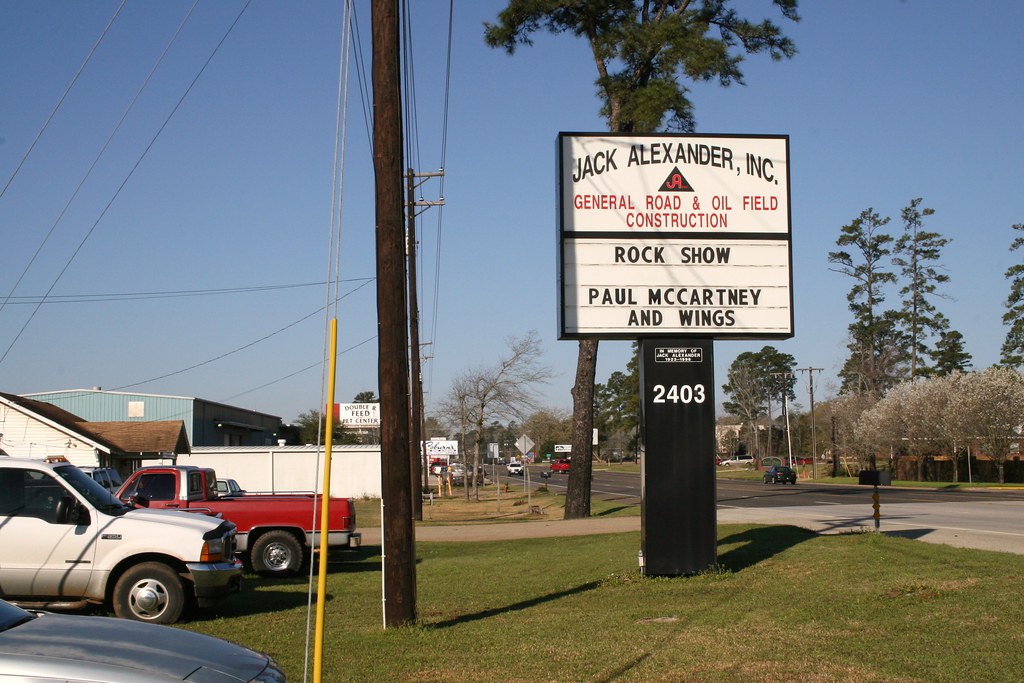 Apparently, the owner of this construction company in Lufkin has an interesting approach to the use of its marquee. I spotted this Wednesday morning and did a double take. I'm befuddled by the message (which was on both sides of the sign). Is it a tribute to the 1975 Paul McCartney and Wings album, Venus and Mars? What else could it be? I'll check it in a week or so to see what's there.....


