When I was a kid, learning to play guitar around 1981, Electro-Harmonix pedals were the Holy Grail of effects pedals. Probably still are. I could sit in a room plugged in through a chorus or delay pedal for literally hours and need nothing else. The NPR All Things Considered Blog has this really cool video in which someone pretty much recreates Pink Floyd's classic "Welcome to the Machine" (from 1975's Wish You Were Here) using only "an electric shaver, a few guitars and a whole lot of pedals." In other words, no keyboards or synthesizers were used.
In honor of 92-year-old Dame Vera Lynn getting back to the top of the British charts, I repost the follwing. According to the linked article in the previous sentence, she has even beaten out Britain's own Beatles for the top spot. Coincidentally, "We'll Meet Again" is used very effectively and poignantly near the beginning of episode one of The Beatles Anthology (04:04).
"We'll Meet Again" is a 1939 song made famous by British singer Vera Lynn with music written by Ross Parker and words by Hughie Charles.
The song is one of the most famous songs of the Second World War era, and resonated with soldiers going off to fight and their families and sweethearts. The assertion that "we'll meet again" is optimistic, as many soldiers did not survive to see their loved ones again. Indeed, the meeting place at some unspecified time in the future would have been seen by many who lost loved ones to be heaven.
The Dukes of Stratosphear was a pseudonym used by the British rock band XTC in the mid to late 1980s, in parallel with XTC's continued musical activities. The project was intended as a homage to 1960s pop and psychedelic music by groups such as the Beatles, The Byrds, The Kinks, The Beach Boys, Pink Floyd and the Pretty Things.
The band only released two records, the EP 25 O'Clock (1985), and the full-length album Psonic Psunspot (1987). The two releases were compiled onto a single CD under the title Chips from the Chocolate Fireball. The Dukes were also mentioned in the credits of XTC's 1986 album Skylarking, where they were thanked for the loan of their guitars.
I bought a copy of this album in a London record shop during the summer of 1985 (at the same time Live Aid was occurring). It's a cherished possession.
I've seen the Dukes' music described as Syd Barrett-era Floyd. That's pretty accurate. One of the really cool things about them was that at least on the first album (25 O'Clock), they recorded using only the technology available to groups in the 1960s. And some critics argue that the members of XTC, free from the pressures of writing "serious" songs, turned in tunes superior to those on official XTC albums of the period. It shouldn't be too much of a surprise, but they even did some videos as The Dukes(!).
This first one is for a great track off of 25 O'Clock called "The Mole from the Ministry." It's the Dukes "rewrite" of "I Am the Walrus." The promotional film appears to be outtakes from Magical Mystery Tour (appropriately enough):
And here is one from Psonic Psunspot titled "You're a Good Man Albert Brown":
I may be the last person in the world to see this, but someone has synced the song "Echoes" from Pink Floyd's Meddle album with the "Jupiter and Beyond the Infinite" segment of my favorite movie of all time, 2001: A Space Odyssey.
The full, complete "Jupiter and Beyond the Infinite" (24 minutes) is here. This is the portion I would describe as being when Dave Bowman begins his voyage "into the infinite" (approx. 4:30 minutes).
Alan Parsons first came to prominence as an engineer on such albums as the Beatles' Abbey Road and Pink Floyd's The Dark Side of the Moon. He was known to have swapped shifts during the engineering of The Dark Side of the Moon so he could work entirely on the album. The Floyd experience would appear to have been extremely influential on the sound of The Alan Parsons Project (not the noted Cambridge physicist Dr. Parsons), the group he founded with producer and songwriter (and occasional singer) Eric Woolfson in 1975.
The "project"
Listen to this and tell me it isn't similar to the mellow, rock sound so prevalent on something like "Eye in the Sky" (I'm not sure if he's responsible for the sound, or if he was simply profoundly influenced by it). For one thing, I think the timbre of Eric Woolfson's voice is similar to David Gilmour's. The heavy use of saxophone on Dark Side would show up on things like Al Stewart's "Year of the Cat," which Parsons produced in 1976. The Project dissolved after 1987, but he still occasionally performs with a group called The Alan Parsons Live Project
Try Anything Once (1993), Parson's first solo album. The cover is overtly Floyd-esque, no?
While the aforementioned "Eye in the Sky" (1982) was their biggest hit, I've always far preferred the 1984 single "Don't Answer Me," from Ammonia Avenue, with its Spector-inspired sound (I love those castanets!). It's a beautiful tune, with a nice video to match. I seem to recall the MTV VJs talking about how the animation used in it was revolutionary:
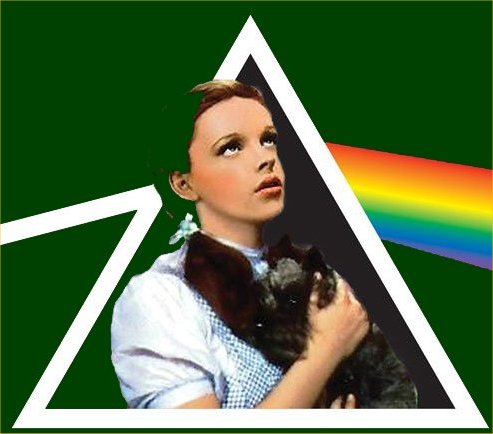
If you're like I am, you were intrigued a few years ago to hear about how when The Wizard of Oz and Pink Floyd's Dark Side of the Moon are properly synced, an odd, even unsettling, series of coincidental moments occur. And if you are like me, you were ultimately not intrigued enough to actually attempt to do it yourself. Well, finally someone has done it for you (and me). Here's the whole thing in all its creepy splendor (offically called the "Dark Side of the Rainbow"):
It's not as if The Wizard of Oz isn't disturbing enough as it is...
 When I was a kid, learning to play guitar around 1981, Electro-Harmonix pedals were the Holy Grail of effects pedals. Probably still are. I could sit in a room plugged in through a chorus or delay pedal for literally hours and need nothing else. The NPR All Things Considered Blog has this really cool video in which someone pretty much recreates Pink Floyd's classic "Welcome to the Machine" (from 1975's Wish You Were Here) using only "an electric shaver, a few guitars and a whole lot of pedals." In other words, no keyboards or synthesizers were used.