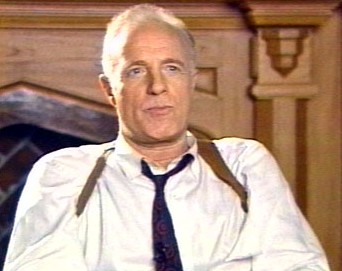
Before the motorcycle accident that apparently left him with no greater career opportunities than I'm with Busey and Celebrity Fit Club, Gary Busey was considered to be a good, if not great, actor. Evidence of this fact are the number of awards and nominations he received for his portrayal of Buddy Holly in the 1978 biopic The Buddy Holly Story.
Busey's portrayal of Holly easily parallels, if not surpasses, the work of Kurt Russell in Elvis, Sissy Spacek in Coal Miner's Daughter, or more recently, Joaquin Phoenix in Walk the Line. Like Joaquin Phoenix (who learned to play guitar like Johnny Cash and did his own vocals on the soundtrack), Busey was admired by critics for recording the music for the film live. Buddy Holly goes from age 19 to 22 during the film. Gary Busey was 34 when he played the role of Holly. Busey reportedly lost thirty-two pounds to look more like Holly, who was 146 lbs at the time of his death. If Gary Busey is remembered for only one thing, let it be his performance of Buddy's "True Love Ways" at the end of the film. Busey is wonderful in the entire film, but there is something particularly special about that scene. Perhaps it's just the song(?).
"True Love Ways" was co-written by Buddy and his producer, Norman Petty, and recorded in October, 1958. This and "It Doesn't Matter Anymore" (written by Paul Anka) were Buddy's first (and only) recordings to use orchestral string arrangements. It wasn't released until after Holly's death in 1959. After he died in a plane crash, the album The Buddy Holly Story was released, which contained many of his early hits. The Buddy Holly Story 2 album came out a few months later and included many of his lesser-known songs, including "True Love Ways."
This scene is a fictional depiction of the night of Holly's last performance, in Clear Lake, Iowa, on February 2, 1959, as a part of the Winter Dance Party tour. Again, if Gary Busey were to be remembered for only one thing, let it be for this:
#39 on Rolling Stone's 500 Greatest Songs of All Time, "That'll Be the Day" was written primarily by Cricket's drummer Jerry Allison, with contributions from Buddy Holly, and later in the recording studio, from producer Norman Petty. It reached number 1 on the U.S. and U.K. charts in 1957, and it was Buddy Holly and The Cricket's first hit. Supposedly Holly and Allison were inspired by John Wayne's use of the phrase in The Searchers (1956). The YouTube video is a 1957 performance from The Ed Sullivan Show (I believe). The band personnel are drummer Jerry Allison, bassist Joe B. Mauldin, and rhythm guitarist Niki Sullivan.
I'm a huge fan and consumer of almost everything Rockstar Games produces. Just as I should be completing Grand Theft Auto: Vice City Stories, this summer, Manhunt 2 will be released. It appears to be even more disturbed and disturbing than its predecessor (yippee!). Here's the latest trailer:
From the Wikipedia entry: "Raymond Thornton Chandler (July 23, 1888 – March 26, 1959) was an author of crime stories and novels. His influence on modern crime fiction has been immense, particularly in the writing style and attitudes that much of the field has adopted over the last 60 years. Chandler's protagonist, Philip Marlowe, has become synonymous with the tradition of the hard-boiled private detective, along with Dashiell Hammett's Sam Spade.
He taught himself to write pulp fiction in an effort to draw an income from his creative talents, and his first story, "Blackmailers Don't Shoot," was published in Black Mask in 1933. His first novel, The Big Sleep, was published in 1939.
Chandler worked as a Hollywood screenwriter following the success of his novels, working with Billy Wilder on James M. Cain's novel Double Indemnity (1944), and writing his only original screenplay, The Blue Dahlia (1946). Chandler also collaborated on the screenplay of Alfred Hitchcock's Strangers on a Train (1951), a story he thought implausible (Chandler was notorious for his intense dislike of Alfred Hitchcock, whom he often referred to as "that fat bastard").
Chandler's finely wrought prose was widely admired by critics and writers from W.H. Auden, Evelyn Waugh to Ian Fleming. Although his swift-moving, hardboiled style was inspired largely by Dashiell Hammett, his use of both sharp and lyrical similes in this context was quite original. Turns of phrase such as The muzzle of the Luger looked like the mouth of the Second Street tunnel, and The minutes went by on tiptoe, with their fingers to their lips, defines private eye fiction and a Chandleresque literary style, which is also the subject and object of innumerable parodies and pastiches.
However, his most famous character, Philip Marlowe, is not a stereotypical tough guy, but rather a complex and sometimes sentimental figure who has few friends, attended college for awhile, speaks a little Spanish, at times admires Mexicans, and is a student of chess and classical music. He will also refuse money from a prospective client if he is not satisfied that the job meets his ethical standards.
(His wife) died in 1954 after a long illness, during which Chandler was writing The Long Goodbye. Lonely and depressed, he turned once again to drink and never again turned away for long. His writing suffered in quality and quantity, and he attempted suicide in 1955. His life was both helped and complicated by the women who attracted his attention, notably Helga Greene (his literary agent); Jean Fracasse (his secretary); and Sonia Orwell (George Orwell's widow), who believed Chandler was a repressed homosexual. After a stay in England he moved back to La Jolla where he died, of alcoholism and pneumonia, at the Scripps Clinic. Helga Greene was awarded his estate after a legal wrangle with Fracasse. Chandler was buried at Mount Hope Cemetery, in San Diego. According to Frank MacShane, the author of The Raymond Chandler Papers, the struggle over his estate resulted in Chandler being interred in a section reserved for paupers and indigents."
“ I see him always in a lonely street, in lonely rooms, puzzled but never quite defeated,... ” —In a letter to a curious fan regarding Philip Marlowe's character and habits in Raymond Chandler: Speaking
“ From thirty feet away she looked like a lot of class. From ten feet away she looked like something made up to be seen from thirty feet away. ” —The High Window
"She gave me a smile I could feel in my hip pocket" —Farewell, My Lovely (Chapter 18)
"I was neat, clean, shaved and sober, and I didn't care who knew it." —The Big Sleep (Chapter 1)
"It was a blonde. A blonde to make a bishop kick a hole in a stained glass window." —Farewell, My Lovely (Chapter 13)
"I never saw any of them again - except the cops. No way has yet been invented to say goodbye to them." —The Long Goodbye (Chapter 52)
QUOTE: "There's no excusing Imus' recent ridiculous remark, but there's something not kosher in America when one guy gets a Grammy and one gets fired for the same line."
Nacogdoches on Main, Fredonia, Pecan and Church Streets, Saturday morning, 7am.
Memories on Main Street antique store
Sherry Ward Fine Arts Studio's display window advertising the exhibition of a BFA (Bachelor of Fine Arts) Thesis Exhibition called Complicating Communication
Looking west down Main Street toward Commercial Bank
This is an excellent performance of it by Louis Armstrong in Copenhagen, around 1933. I can't get over how good the microphones were:
But with all due respect to Satchmo, no one could squeeze the emotion from the notes of a song like Frank Sinatra. He recorded a version for the Where Are You album in 1957. Here is a bit of Sinatra's interpretation.
 Before the motorcycle accident that apparently left him with no greater career opportunities than I'm with Busey and Celebrity Fit Club, Gary Busey was considered to be a good, if not great, actor. Evidence of this fact are the number of awards and nominations he received for his portrayal of Buddy Holly in the 1978 biopic The Buddy Holly Story.
 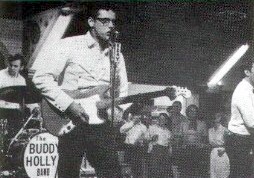 Busey's portrayal of Holly easily parallels, if not surpasses, the work of Kurt Russell in Elvis, Sissy Spacek in Coal Miner's Daughter, or more recently, Joaquin Phoenix in Walk the Line. Like Joaquin Phoenix (who learned to play guitar like Johnny Cash and did his own vocals on the soundtrack), Busey was admired by critics for recording the music for the film live. Buddy Holly goes from age 19 to 22 during the film. Gary Busey was 34 when he played the role of Holly. Busey reportedly lost thirty-two pounds to look more like Holly, who was 146 lbs at the time of his death. If Gary Busey is remembered for only one thing, let it be his performance of Buddy's "True Love Ways" at the end of the film. Busey is wonderful in the entire film, but there is something particularly special about that scene. Perhaps it's just the song(?).
 "True Love Ways" was co-written by Buddy and his producer, Norman Petty, and recorded in October, 1958. This and "It Doesn't Matter Anymore" (written by Paul Anka) were Buddy's first (and only) recordings to use orchestral string arrangements. It wasn't released until after Holly's death in 1959. After he died in a plane crash, the album The Buddy Holly Story was released, which contained many of his early hits. The Buddy Holly Story 2 album came out a few months later and included many of his lesser-known songs, including "True Love Ways."
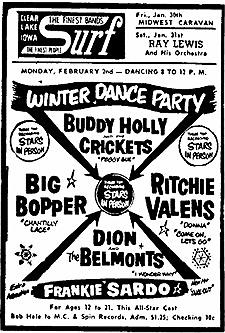 This scene is a fictional depiction of the night of Holly's last performance, in Clear Lake, Iowa, on February 2, 1959, as a part of the Winter Dance Party tour. Again, if Gary Busey were to be remembered for only one thing, let it be for this: