I really like this re-working, re-imagining of Buddy Holly's song "Everyday." Talk about a cover version. It's practically a different song, but yet not. A bit jarring at first to fans of the original, Rogue Wave's redesign is pretty flippin' cool. I bet even ol' Buddy Holly himself would approve. It's on the soundtrack to a 2005 videogame I've never heard of, and I consider myself something of a videogame nerdingerster.
The way I see it, without Buddy Holly there wouldn't have been a Beatles, or at the very least, there'd have been a profoundly different Beatles. For example, would John Lennon have so confidently worn glasses from 1967 onwards if it weren't for Buddy Holly? Would they have written "Love Me Do" or "Please, Please Me" or "She Loves You"?? Would Lennon have thought of "Beatles"???
Before the motorcycle accident that apparently left him with no greater career opportunities than I'm with Busey and Celebrity Fit Club, Gary Busey was considered to be a good, if not great, actor. Evidence of this fact are the number of awards and nominations he received for his portrayal of Buddy Holly in the 1978 biopic The Buddy Holly Story.
Busey's portrayal of Holly easily parallels, if not surpasses, the work of Kurt Russell in Elvis, Sissy Spacek in Coal Miner's Daughter, or more recently, Joaquin Phoenix in Walk the Line. Like Joaquin Phoenix (who learned to play guitar like Johnny Cash and did his own vocals on the soundtrack), Busey was admired by critics for recording the music for the film live. Buddy Holly goes from age 19 to 22 during the film. Gary Busey was 34 when he played the role of Holly. Busey reportedly lost thirty-two pounds to look more like Holly, who was 146 lbs at the time of his death. If Gary Busey is remembered for only one thing, let it be his performance of Buddy's "True Love Ways" at the end of the film. Busey is wonderful in the entire film, but there is something particularly special about that scene. Perhaps it's just the song(?).
"True Love Ways" was co-written by Buddy and his producer, Norman Petty, and recorded in October, 1958. This and "It Doesn't Matter Anymore" (written by Paul Anka) were Buddy's first (and only) recordings to use orchestral string arrangements. It wasn't released until after Holly's death in 1959. After he died in a plane crash, the album The Buddy Holly Story was released, which contained many of his early hits. The Buddy Holly Story 2 album came out a few months later and included many of his lesser-known songs, including "True Love Ways."
This scene is a fictional depiction of the night of Holly's last performance, in Clear Lake, Iowa, on February 2, 1959, as a part of the Winter Dance Party tour. Again, if Gary Busey were to be remembered for only one thing, let it be for this:
#39 on Rolling Stone's 500 Greatest Songs of All Time, "That'll Be the Day" was written primarily by Cricket's drummer Jerry Allison, with contributions from Buddy Holly, and later in the recording studio, from producer Norman Petty. It reached number 1 on the U.S. and U.K. charts in 1957, and it was Buddy Holly and The Cricket's first hit. Supposedly Holly and Allison were inspired by John Wayne's use of the phrase in The Searchers (1956). The YouTube video is a 1957 performance from The Ed Sullivan Show (I believe). The band personnel are drummer Jerry Allison, bassist Joe B. Mauldin, and rhythm guitarist Niki Sullivan.


 Before the motorcycle accident that apparently left him with no greater career opportunities than I'm with Busey and Celebrity Fit Club, Gary Busey was considered to be a good, if not great, actor. Evidence of this fact are the number of awards and nominations he received for his portrayal of Buddy Holly in the 1978 biopic The Buddy Holly Story.
 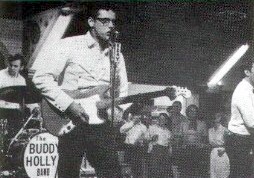 Busey's portrayal of Holly easily parallels, if not surpasses, the work of Kurt Russell in Elvis, Sissy Spacek in Coal Miner's Daughter, or more recently, Joaquin Phoenix in Walk the Line. Like Joaquin Phoenix (who learned to play guitar like Johnny Cash and did his own vocals on the soundtrack), Busey was admired by critics for recording the music for the film live. Buddy Holly goes from age 19 to 22 during the film. Gary Busey was 34 when he played the role of Holly. Busey reportedly lost thirty-two pounds to look more like Holly, who was 146 lbs at the time of his death. If Gary Busey is remembered for only one thing, let it be his performance of Buddy's "True Love Ways" at the end of the film. Busey is wonderful in the entire film, but there is something particularly special about that scene. Perhaps it's just the song(?).
 "True Love Ways" was co-written by Buddy and his producer, Norman Petty, and recorded in October, 1958. This and "It Doesn't Matter Anymore" (written by Paul Anka) were Buddy's first (and only) recordings to use orchestral string arrangements. It wasn't released until after Holly's death in 1959. After he died in a plane crash, the album The Buddy Holly Story was released, which contained many of his early hits. The Buddy Holly Story 2 album came out a few months later and included many of his lesser-known songs, including "True Love Ways."
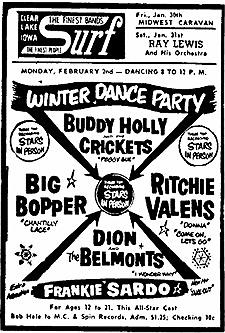 This scene is a fictional depiction of the night of Holly's last performance, in Clear Lake, Iowa, on February 2, 1959, as a part of the Winter Dance Party tour. Again, if Gary Busey were to be remembered for only one thing, let it be for this:

